June 23, 2010

Insect Appreciation

by Susan Post

A walk on any trail this time of year may offer the expected deer, numerous bird calls, and blooming summer flowers, but it is the insects, common or rare, that are a delight. It is these unexpected encounters that will hold your interest and pique your curiosity during any forays outdoors.

Look in shady areas of dense vegetation for scorpionflies. While they resemble flies, these insects have two pairs of wings instead of one, like flies, and belong to the insect order Mecoptera. Their head is elongated and if you happen to encounter a male, its genitalia are large and conspicuous and carried curved upward over the back like the sting of a scorpion. Crane flies also may be found in this habitat. These large, mosquito-like insects will hang motionless on stinging nettle, but don't be afraid; while rather large, these insects don't bite, in fact, most don't feed at all as adults.

Wet areas offer a plethora of observations from the whimsical gyrations of whirligig beetles to the defense of territories by damselflies and dragonflies. Summer is the time for many of the large dragonflies to gather in groups. Watch for them as they swoop and dive, catching the abundant insect prey. Along the edges of moist areas look for large gatherings of butterflies and skippers. These gatherings are called puddle clubs and are the purview of newly emerged bachelor males. It is thought that these males, by being together, are creating a "super male" to attract the fancy of passing females.

While clouds of butterflies disturbed from a puddle club are fun to walk through, the single butterfly sitings are no less exciting. From buckeyes to painted ladies to swallowtails, their effortless flitting is a signal of the coming days of summer fun. But what about the moths? A chance encounter of a luna, cecropia, or polyphemus is quite remote during the day.

To increase your moth sighting chances, perhaps a light trap is in order. By using a white sheet and a bright white light source, you have created a beacon in the dark which moths and other night flying insects are attracted to. The insects fly toward the light and hit the sheet, climbing around on the sheet so you are able to get close to study them. During the night, check the trap often as different insects fly at different times. If you don't have access to a light, walk around your hometown checking the bright white lights—an entomological friend spent his youth checking the lights at the local laundromat and gas station.

Take time during these warm days of summer to view some of the many and unusual insects that grace the Illinois landscape.

June 18, 2010

The Western Forest-Prairie Division

Located to the West of the Grand Prairie Division in Illinois, along the Illinois River valley, our 5th division, the Western Forest-Prairie Division, encompasses much of Mercer, Warren, Knox, Fulton, Peoria, McDonough, Schuyler, Brown, Adams, Morgan, Scott, Macoupin, Greene, Jersey, and Hancock Counties as well as parts of Henderson, Rock Island, Pike, Cass Counties (map).

Here the landscape consists of level to rolling uplands interspersed with deeply cut rivers and ravines with well-developed floodplains. It is a land of deep, forested ravines with intervening flat prairie openings. The area was covered by Illinoian age glaciers. Bedrock outcroppings are common in some locations. This division has two sections—Galesburg and Carlinville—separated by the Illinois River valley.

The Galesburg Section is north of the Illinois River valley; both the Spoon and La Moine rivers drain this area. The amount of prairie here once almost equaled the amount of forest. One interesting habitat type is the dry-mesic barren, also known as an oak opening. In the spring at Argyle Hollow Barrens Nature Preserve look for the very unusual bi-colored bird’s foot violets growing among the mounds of lichens and mosses.

The Carlinville Section is southeast of the Illinois River valley. Macoupin Creek and the Illinois River are the major streams that drain this section. The original vegetation of this section was forest, with only 12% of the area in prairie. Very little prairie or forest remains today in this section.

To experience this area, visit Siloam Springs and Arglye Lake State Parks.

June 8, 2010

The Grand Prairie

This week we look at the fourth natural division, the Grand Prairie Division. This area encompasses much of Illinois, from as far north as Ogle County, south to Shelby County, west to Henry County and east to the Indiana border (map).

This area, the largest natural division of the state, is a vast plain formerly occupied by tall-grass prairie. The grassland landscape was so unusual that early travelers had to turn to the sea for analogies, evoking “a sea of grass” or “a vast ocean of meadow-land.” In time this landscape came to be known as “prairie.” The fertile soils are young and high in organic content. They were developed from deposited loess, lakebed sediments, and glacial drift. Natural drainage was poor resulting in many marshes and prairie potholes. The prairies were a veritable wildflower garden containing several hundred species of grasses and forbs.

Forests interrupted the landscape on floodplains, on slopes bordering streams, along river bends, and in isolated prairie groves. Like their prairie counterparts, prairie groves have a remarkable number of plant species, especially spring-blooming herbs.In addition to the more common moist forest and prairie communities, dolomite, loess hill, and shrub prairies are found here, as well as barrens, sandstone cliffs, eroding bluffs, sand savannas, and sand ponds. This division has five sections— Grand Prairie, Springfield, Western, Green River Lowland and Kankakee Sand Area.

While much of the prairie has been lost, there are remnants and restorations including Goose Lake Prairie State Park, Midewin National Tallgrass Prairie, Allerton Park, and Kennekuk Cove County Park. Spitler Woods State Natural Area shows a prairie grove habitat and is one of the largest stands of old growth woods in Central Illinois.

June 7, 2010

Dragonflies

By Susan Post

Illinois has 98 species of dragonflies, all of which are descendants of a prehistoric group at least 250 million years old that included some of the largest insects that ever lived. If any of your summer’s wanderings take you near water, take a few minutes to enjoy the iridescent dragonflies.

Dragonflies begin their life in the water as a dull colored, predatory larvae, called a naiad. They are equipped with large, chewing mouthparts with a lower lip that rapidly extends to capture and hold their prey. A meal is made of any unfortunate small crustacean, minnow, tadpole, or other insect larvae that gets in its path. They are able to search the water for prey by expelling water through gills at the end of their abdomen, somewhat like a hydraulic cannon or a jet engine.

After one or more years of aquatic life, if the larvae have been able to avoid the attention of fish, their chief predators, they will climb out of the water and metamorphose into an adult. Supporting two pair of rigid, transparent wings, which are held outstretched even at rest, and a thick body, dragonflies do not give any outward appearance of grace on the wing. But can they fly! Some species have been clocked at 60 miles per hour as they fly forward, backward, or sideways.

Their eyes are the largest in the insect world, providing the dragonflies excellent eyesight. They can observe insect prey up to forty yards away. Their forward thrust legs are located in a cluster near the front of the thorax and are arranged in a basketlike way to catch prey and quickly transfer it to the mouth. Dragonflies are so well-adapted as airborne predators that their legs are nearly useless for walking.


Their fierce appearance has granted them all sorts of nasty abilities and names. The unenlightened once thought dragonflies were capable of sewing shut the mouths of men who cursed and women who scolded, or they sewed up the ears of people who enjoyed gossip. From these myths a variety of names sprung up such as—snake doctors, horse stingers, sewing needles, and the Devil's darning needle. The myths and names are in reference to the distinctive shape of their abdomen and the mistaken belief that dragonflies are capable of inflicting stings and were harmful to humans. The only harm these insects do is to mosquitoes, gnats and flies, some of their favorite food items, thus earning them the well-deserved name of mosquito hawk.


May 28, 2010

Green Tiger Beetle

by Susan Post

Walks along sunny paths in late spring woodlands are likely to yield a harvest of jewels. No, these cannot be collected and mounted in a ring; rather, they are emerald green tiger beetles, small but fierce denizens of the forest.

With the sun shining off its irisdescent blue-green elytra, the green tiger beetle resembles an emerald lost on a sandy path. A closer inspection usually reveals nothing—the "emerald" has flown several feet down the path.

Green tiger beetle adults are slender predatory beetles with long legs, large eyes, and thread-like antennae. Like all chewing insects they have a pair of mandibles. The tiger beetle's mandibles are sickle-shaped and very sharp pointed, with several teeth on the inner face. The name tiger beetle refers to its predaceous habits (both adults and larvae eat all kinds of insects) and to the ability of the adults to suddenly pounce on their prey.

During the summer months females will deposit their eggs in sandy soil. The eggs are deposited singly, each in a separate burrow. The larvae are whitish, S-shaped and grub-like with long curving jaws and a large hard head. The larvae prop themselves up in vertical burrows with their oddly shaped heads often plugging the entrance. They wait with open mandibles for a hapless victim, which they seize and take to the bottom of the burrow (sometimes a foot below the surface) to devour at their leisure. On the larva's 5th abdominal segment is a spine that anchors it to the side of the burrow. Thus, if a larva grabs an insect that is too large to overcome, it is anchored to the burrow and will not be pulled out.

The tiger beetle has 3 larval instars, that is, it sheds its exoskeleton three times in order to grow larger. Unlike most insects that just molt and go about their business, prior to each molt the tiger beetle larva must undertake an extra step and enlarge its burrow to accommodate its soon-to-be bulkier self. Pupation takes place in a chamber dug off the main tunnel and the entire life cycle will take up to 3 years.

For those lucky enough to catch one of these iridescent emeralds of the woods, be careful with this jewel of the beetle world for it is not merely ornamental. Tiger beetle mandibles, lethal to most small creatures, can inflict a very effective bite on unsuspecting fingers!

May 25, 2010

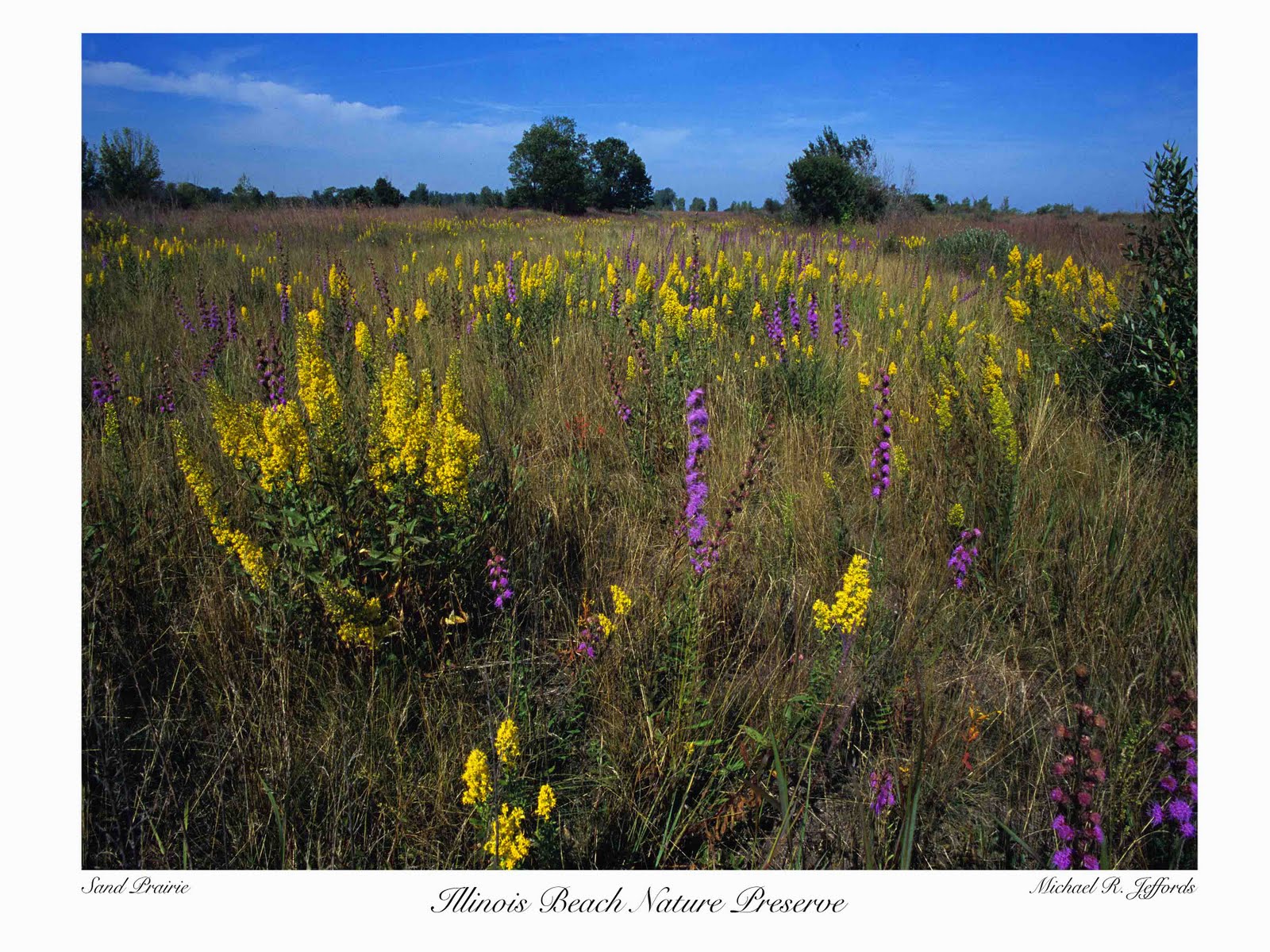
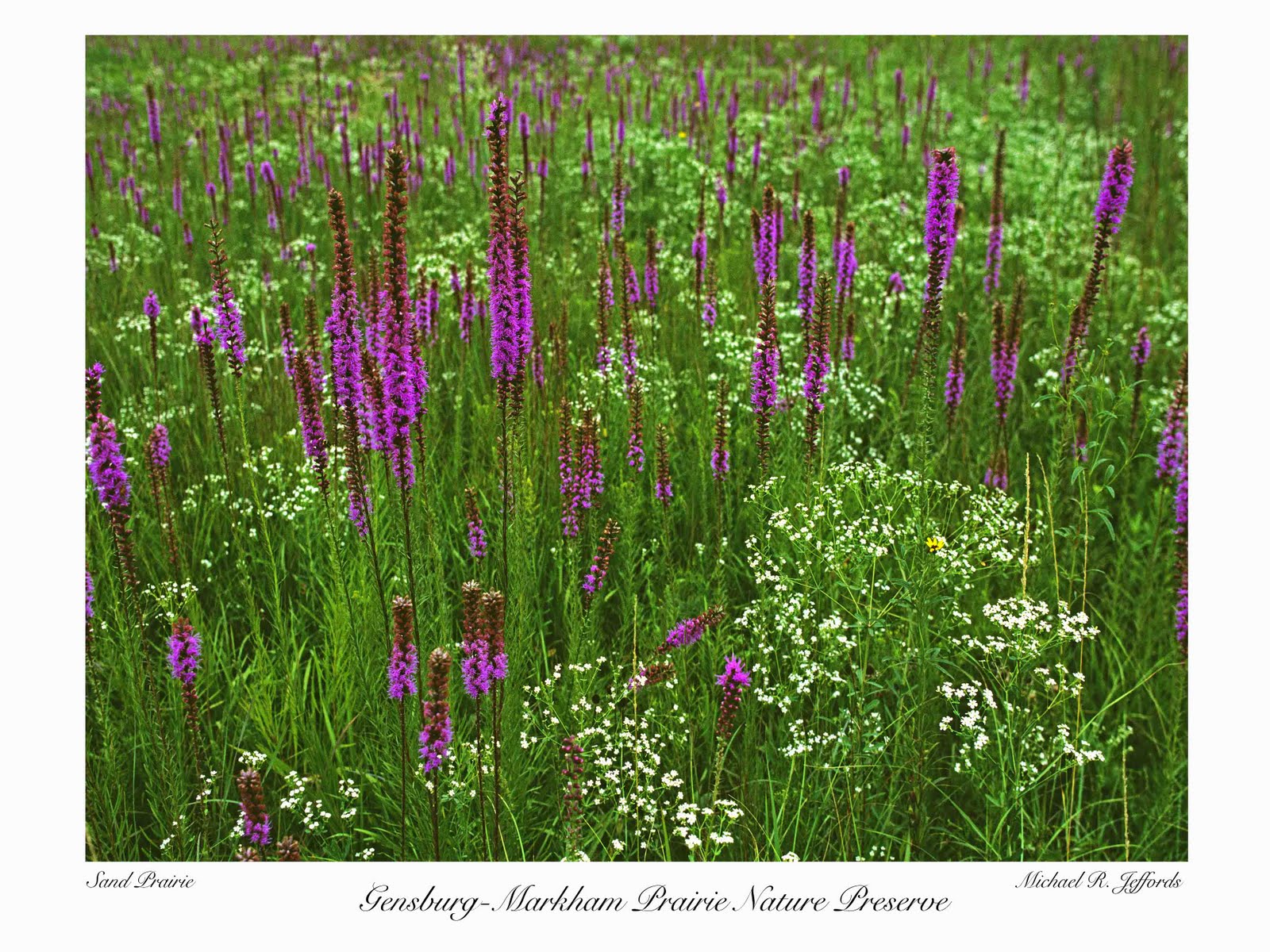
Why Natural Areas? Why Take Pictures? Why do we Care?

by Michael Jeffords
As I drive south for more than 3 hours to give a talk at Southern Illinois University for an unknown audience, assuming one shows up, I think of my spouse’s comment as I left the house. “Why are you doing this?” she said. “I thought you were going to learn to say no!” This leads to a little soul-searching (very little actually) as to what propels me to give the seemingly endless array of presentations that I do, some 1200 over the last 25 years.

The answer is quite simple really. I like it! Also, it is my way of trying to change the world, at least a little corner of it. Whatever skill I may have acquired as a photographer over the years, as well as the thousands of images I have accumulated, mostly of wild places in Illinois, must be put to some use. Now I could attempt to make a living selling images for the marketplace, but I would likely starve pursuing that avenue. I choose to use photography as a tool for education. Fortunately, I have a “day job” that allows me to do this on a regular basis—thus, my jaunt to southern Illinois.


Most of the presentations I make revolve around the central theme of “biodiversity,” the great array of life that covers our planet, and the focus is, inevitably, Illinois. People seem to want to know about 'natural Illinois.' I have found that my niche in all of this may be to recreate that intimate contact with nature that is missing from most individuals’ lives in today’s world. There is, there must be, more to life than malls, minivans, and movie theaters if we are to preserve a significant portion of the life that exists around us.


It is thought that humans have an innate urge to affiliate with other forms of life; this theory, termed “biophilia,” is eloquently described by prominent Harvard biologist E. O. Wilson. The hypothesis also states that biophilia is only partly genetic and must be nurtured from a relatively early age if it is to manifest itself in an individual. I view my role as a “biophilia facilitator” via the medium of photography. I have long since given up on the concept that humans will preserve the earth’s biodiversity based solely on its potential economic value to us. Exploitation wins out over conservation in virtually every instance. If we preserve biodiversity, we are not likely to do it for any direct benefit it may provide to us, but because we choose to, and because we like being surrounded by an endless multitude of fascinating places and organisms.


Ideally, we could take all skeptical individuals into the world’s great natural habitats—the Amazonian rainforest, the African veldt, the Great Barrier Reef— and let them experience their biodiversity firsthand. While this is sometimes possible, it is far more feasible to present images of the natural world to them in a context that says, “These organisms, these places are wonderful and are worth preserving for their own sake.” If these sites happen to be in their own region, their own state, even their own backyard, then the message becomes powerful and provides a first line for nurturing biophilia. It is my experience that the visual elegance of the natural world, no matter where it may be found, is its own best friend and can sell itself if it is given the chance.


As I look back over the last 30 years, I know why I seldom say no to groups who want talks on biodiversity. If they seek knowledge and awareness of the natural world, the least I can do is attempt to provide it. I also believe that the natural areas of the earth, of the U.S., of Illinois, and their organisms deserve to be portrayed in as favorable a light as possible. It ultimately falls on the presenter—in this case, me—to be (sorry, U.S. Army) “all that I can be” with regard to photography. It also falls on us, the citizens of Illinois, when given the opportunity for preservation over exploitation, to choose the former, each and every time.


Every program, each visit to a natural area, the individual "grains of biodiversity" encountered, might add that pivotal sand grain to a person’s psyche that tips the balance in favor of preservation, and that can only be good. Person by person, sand grain by sand grain, we just might make a difference.