Showing posts with label Communicating Nature. Show all posts

May 25, 2010

Why Natural Areas? Why Take Pictures? Why do we Care?

by Michael Jeffords
As I drive south for more than 3 hours to give a talk at Southern Illinois University for an unknown audience, assuming one shows up, I think of my spouse’s comment as I left the house. “Why are you doing this?” she said. “I thought you were going to learn to say no!” This leads to a little soul-searching (very little actually) as to what propels me to give the seemingly endless array of presentations that I do, some 1200 over the last 25 years.

The answer is quite simple really. I like it! Also, it is my way of trying to change the world, at least a little corner of it. Whatever skill I may have acquired as a photographer over the years, as well as the thousands of images I have accumulated, mostly of wild places in Illinois, must be put to some use. Now I could attempt to make a living selling images for the marketplace, but I would likely starve pursuing that avenue. I choose to use photography as a tool for education. Fortunately, I have a “day job” that allows me to do this on a regular basis—thus, my jaunt to southern Illinois.


Most of the presentations I make revolve around the central theme of “biodiversity,” the great array of life that covers our planet, and the focus is, inevitably, Illinois. People seem to want to know about 'natural Illinois.' I have found that my niche in all of this may be to recreate that intimate contact with nature that is missing from most individuals’ lives in today’s world. There is, there must be, more to life than malls, minivans, and movie theaters if we are to preserve a significant portion of the life that exists around us.


It is thought that humans have an innate urge to affiliate with other forms of life; this theory, termed “biophilia,” is eloquently described by prominent Harvard biologist E. O. Wilson. The hypothesis also states that biophilia is only partly genetic and must be nurtured from a relatively early age if it is to manifest itself in an individual. I view my role as a “biophilia facilitator” via the medium of photography. I have long since given up on the concept that humans will preserve the earth’s biodiversity based solely on its potential economic value to us. Exploitation wins out over conservation in virtually every instance. If we preserve biodiversity, we are not likely to do it for any direct benefit it may provide to us, but because we choose to, and because we like being surrounded by an endless multitude of fascinating places and organisms.


Ideally, we could take all skeptical individuals into the world’s great natural habitats—the Amazonian rainforest, the African veldt, the Great Barrier Reef— and let them experience their biodiversity firsthand. While this is sometimes possible, it is far more feasible to present images of the natural world to them in a context that says, “These organisms, these places are wonderful and are worth preserving for their own sake.” If these sites happen to be in their own region, their own state, even their own backyard, then the message becomes powerful and provides a first line for nurturing biophilia. It is my experience that the visual elegance of the natural world, no matter where it may be found, is its own best friend and can sell itself if it is given the chance.


As I look back over the last 30 years, I know why I seldom say no to groups who want talks on biodiversity. If they seek knowledge and awareness of the natural world, the least I can do is attempt to provide it. I also believe that the natural areas of the earth, of the U.S., of Illinois, and their organisms deserve to be portrayed in as favorable a light as possible. It ultimately falls on the presenter—in this case, me—to be (sorry, U.S. Army) “all that I can be” with regard to photography. It also falls on us, the citizens of Illinois, when given the opportunity for preservation over exploitation, to choose the former, each and every time.


Every program, each visit to a natural area, the individual "grains of biodiversity" encountered, might add that pivotal sand grain to a person’s psyche that tips the balance in favor of preservation, and that can only be good. Person by person, sand grain by sand grain, we just might make a difference.


April 14, 2010

The Perception of Plants


by Michael R. Jeffords

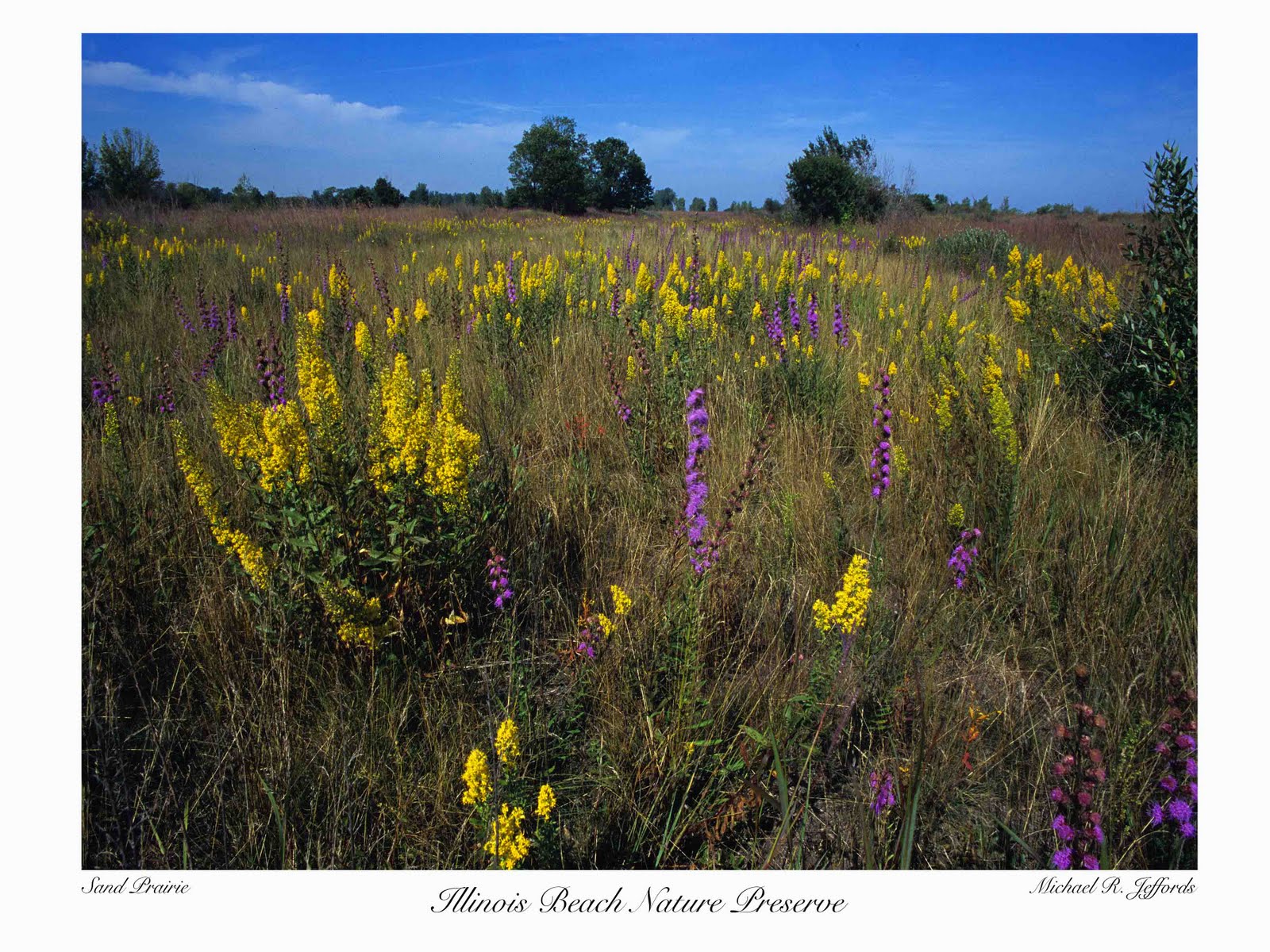
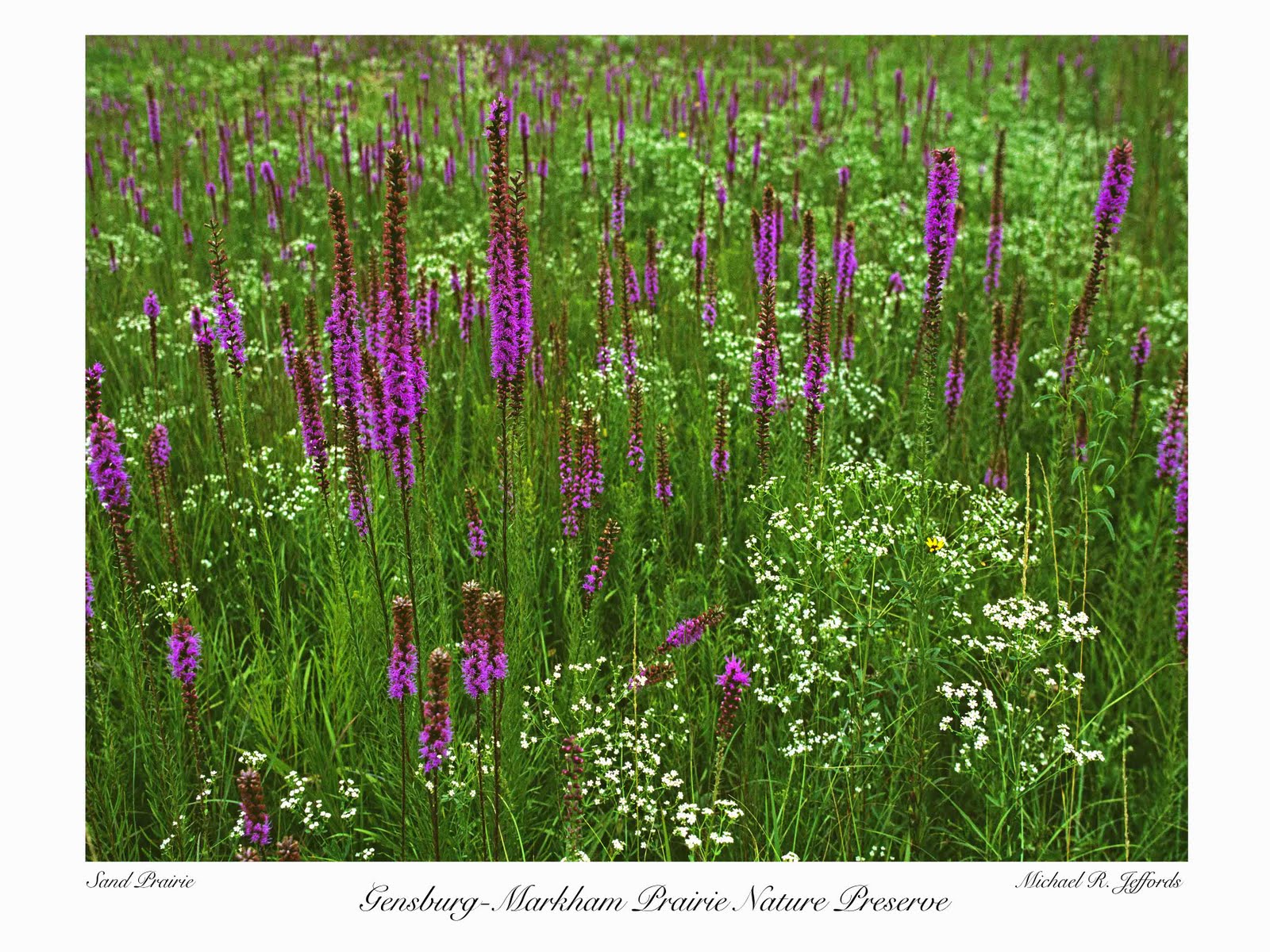
I really shouldn’t admit it, entomologist that I am, but I have a soft spot for plants. Actually, the soft spot is for plants growing in a natural setting. Many of my zoological colleagues do not share this view. A rather famous Illinois scientist, who shall remain nameless, has written: “Plants can be attractive when flowering and might cause me to pause for reflection, but they are not compelling enough to cause me much excitement . . . Plants hold diminished interest for me and become a backdrop for more active wildlife.” In perceiving nature, many are similarly constrained or biased. I call this the “charismatic megafauna syndrome.” For example, millions of people travel to Yellowstone each year, and few, if any, traffic pileups are caused by a lone glacier lily or a clump of Indian paintbrush on a mountain slope. Let one bison, elk, bighorn sheep, or even a lowly coyote walk within viewing range, though, and all traffic laws are suspended. The park roads soon resemble the Dan Ryan at 5 o’clock on a Friday when the Cubs, White Sox, and Bulls are playing and Soldier Field is hosting a Grateful Dead concert. Perhaps we in Illinois are similarly biased as we zoom by that tiny prairie remnant, laced with compass plants and coneflowers.

At perhaps the opposite pole, from Charles Darwin, a person we instinctively associate with animal evolution, comes this perception: “A traveler should be a botanist, for in all views plants form the chief embellishment. Group masses of naked rock, even in the wildest forms, may for a while afford a sublime spectacle, but they will soon grow monotonous. Paint them with bright and varied colors and they become fantastic, clothe them with vegetation and they must form a decent, if not beautiful, picture.”

During the past million years or so, we humans have spent most of our existence struggling for survival against an often harsh, chaotic environment. In today’s world, we have diminished the wildness and achieved dominion over the landscape. Humans have changed the wilderness into a tamed, dressed-up, formal arrangement. Flowers are grown with mathematical precision, and trees and shrubs are manicured to stylistic simplicity. Even our animals sometimes reflect this tendency (the poodle comes to mind). As a photographer, I find myself craving wildness—looking for what James Gleick called “the essence of the earth’s beauty . . . the tangled filigrees of unbridled vegetation.”

A photographic vision of wild plants in a landscape may allow a person to develop a rapport with and empathy for that landscape. These feelings can be established natural area by natural area, plant by plant, stamen by stamen, until an otherwise extremely intimidating, complex expanse of wild landscape (should we be able to find one) can be grasped and appreciated. I find that photography is an extremely powerful instructional and motivational tool, and the way we use it to introduce individuals to the wildness of nature can have a lasting effect.

A final comment about photographing plants: Perceiving a natural landscape, any natural landscape, regardless of size, is equivalent to viewing history. Species indigenous to a given area, or natural habitats that exist in relatively pristine conditions, are windows to the past. Knowing that George Rogers Clark or Père Marquette would probably have gazed upon the same scene I am viewing now is a seminal experience, far better for me than any museum visit. One thing that we, as conservationists, must remember: As wild places diminish, each succeeding generation of children is farther removed from contact with the natural world. In such conditions, plants (and animals) that still exist in wild settings become not only windows to the past, but our keys to the future.

To summarize, there is no right or wrong way to perceive plants (a.k.a. nature). We interpret, select, and filter images through our experience, our emotional responses, and our prejudices and preferences. I sincerely hope that your perception of plants will be both fun and provocative and that you will perceive them not as “a backdrop for more active wildlife” as our earlier friend stated but as entities unto themselves.

March 4, 2010

Photojournaling: Completing the Picture

By Michael R. Jeffords

Webster defines photojournalism as the “photographic presentation of news stories or stories in which a high proportion of pictorial presentation is used.” I could find no definition for photojournaling as I believe I’ve concocted the word to apply to a new artistic endeavor. We are all familiar with the various ways nature photographers and nature writers present their work.


Great photographers provide great images, mostly with short captions or identifying text and an accompanying essay by a well-known writer. The captions often interpret what is viewed within the image. Upon occasion photographic books have images accompanied by excerpts, quotes, and other text from the historical literature. These are meant to inspire by the use of both types of imagery.


Nature writers who rely on only the written word to describe nature and natural phenomena must enter into great detail, describing colors, shapes, relative positions, and overall landscape elements that would be readily evident in a photograph. In this instance the old adage about a picture being worth a thousand words is likely to be true. It simply takes time and words to “create a picture” in the reader’s mind.


So, what exactly is photojournaling and where does it fit into this overall picture? Photojournaling, if I had to define it, is somewhere between all of the above and involves visual images that enlighten, depict, and portray features and organisms in the natural landscape, but fail to complete the entire “aesthetic picture” the individual seeks to portray. The images should be strong enough to negate the need for much explanatory text, yet benefit from the written observations of the photographer. These images basically originate from a “clear mind,” one free of the need to create lengthy descriptive text on what has already been portrayed in the image. In short, these observations can serve to complete the imagery began in the photograph, can even serve to anthropomorphize the subject matter, or create a complete aesthetic picture of an image or series of images.


As a scientist, I have been taught to steer clear of any kind of anthropomorphizing in my research and written words about science, but I’ve found as a photographer, relating what may be viewed as stark nature to the human condition can instill a sense of wonder and enjoyment in the viewers. We all know this is the first step toward developing an engaged public and is the first and perhaps most important step in developing a conservation ethic.