
April 27, 2010

April 23, 2010
Puddle Clubs
by Susan Post
Now that spring has arrived, butterflies are starting to appear in numbers, newly-emerged from hidden chrysalids where most spent the winter. A walk along a sunny path or deserted road through the woods, or along the margin of a lake, pond or stream, may yield a unique opportunity for viewing butterfly puddle-clubbing behavior, the proverbial "boys day out at the old watering hole." Puddle-clubbing is a gathering of bachelor male butterflies, usually of the same species, at a moist spot on the ground. Their bachelor status is confirmed by the absence of tell-tail flight marks on their wings such as scratches or faded color.

For most of us, an encounter with a puddle club occurs only when we are suddenly in the center of a cloud of butterflies, having clumsily walked through the gathering. At times though, usually when the gathering consists of a large showy species, such as the tiger swallowtail, we see the club in time and can observe from a distance. In Illinois, a puddle club may consist of only a few males, or as many as a few dozen. Tropical puddle clubs, however, often consist of several hundred males. A patient watcher often sees the reason for puddle-clubbing.
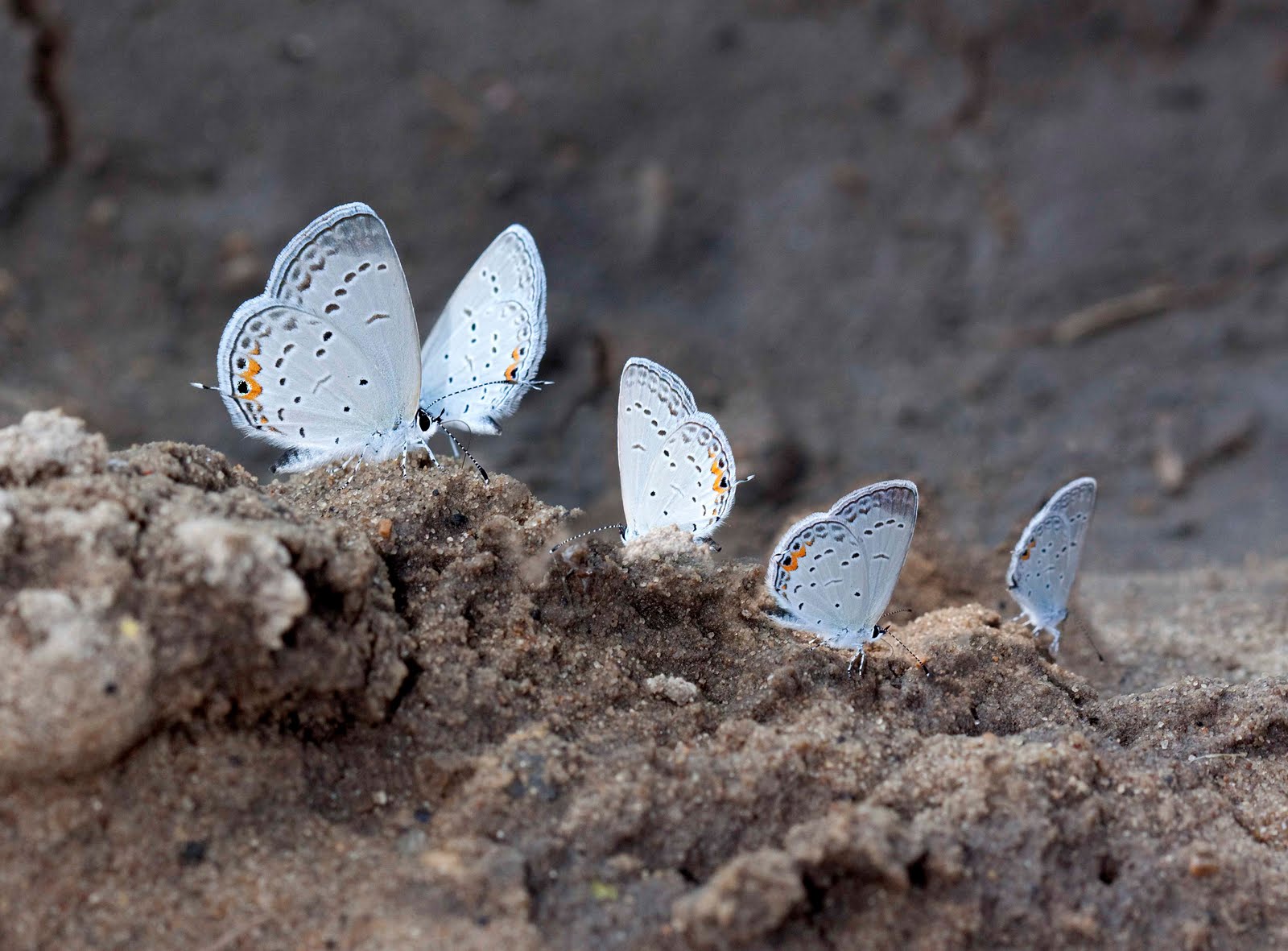
When an appropriate butterfly, usually of the right size and shape, flies near the gathering, males will swarm to meet the newcomer, hoping it to be a female of the same species. If such is the case, several males may initiate courtship behavior; it is then up to the female to choose her favorite. The other suitors may continue to pursue for a time, but most will soon return to await another opportunity. If it should be only another male or another species, the group will quickly settle down again.

Why do butterflies, from the largest swallowtails to the smallest blues or coppers behave this way? No one knows for sure, but entomologists believe that by gathering together, the club creates "a super male", one that is much more likely to attract the fancy of a passing female.


Photos by Michael Jeffords
April 15, 2010
Northeastern Morainal Division
This week, we look at the third natural  division, the Northeastern Morainal Division. This area was the last area of Illinois covered by glaciers during the ice ages and encompasses Cook, Lake, McHenry, DuPage, and Boone Counties as well as parts of Kane, Winnebago and Will Counties (map).
Only 10,000 years ago, this division was covered by glaciers. Glacial landforms such as kames (conical mounds of glacial debris), moraines (long ridges of glacial debris), and eskers (a ridge of sand and gravel from an ancient embedded glacial stream) are common. The old bottom of Lake Chicago (the ancestor of Lake Michigan) is now occupied by the city of Chicago. Sand dunes of varying sizes occur along Lake Michigan. The soils are derived from lakebed sediments, peat, beach deposits, and glacial drift, and range in texture from sand and gravel to silty clay loams. In addition to a variety of prairie and forest communities, this division also has fens (wet prairies with an alkaline water source associated with calcareous springs and seeps), marshes (common because of the poorly drained soils), sedge meadows, and bogs. The only true bogs in the state and all of the state’s glacial lakes are found here, as is a natural beach-and-dunes association. The area is divided into four subsections—the Morainal Section, Lake Michigan Dunes, Chicago Lake Plain, and Winnebago Drift. To experience this division, visit Illinois Beach or Moraine Hills State Parks or Volo Bog State Natural Area.

 division, the Northeastern Morainal Division. This area was the last area of Illinois covered by glaciers during the ice ages and encompasses Cook, Lake, McHenry, DuPage, and Boone Counties as well as parts of Kane, Winnebago and Will Counties (map).
Only 10,000 years ago, this division was covered by glaciers. Glacial landforms such as kames (conical mounds of glacial debris), moraines (long ridges of glacial debris), and eskers (a ridge of sand and gravel from an ancient embedded glacial stream) are common. The old bottom of Lake Chicago (the ancestor of Lake Michigan) is now occupied by the city of Chicago. Sand dunes of varying sizes occur along Lake Michigan. The soils are derived from lakebed sediments, peat, beach deposits, and glacial drift, and range in texture from sand and gravel to silty clay loams. In addition to a variety of prairie and forest communities, this division also has fens (wet prairies with an alkaline water source associated with calcareous springs and seeps), marshes (common because of the poorly drained soils), sedge meadows, and bogs. The only true bogs in the state and all of the state’s glacial lakes are found here, as is a natural beach-and-dunes association. The area is divided into four subsections—the Morainal Section, Lake Michigan Dunes, Chicago Lake Plain, and Winnebago Drift. To experience this division, visit Illinois Beach or Moraine Hills State Parks or Volo Bog State Natural Area.

April 14, 2010
The Perception of Plants

I really shouldn’t admit it, entomologist that I am, but I have a soft spot for plants. Actually, the soft spot is for plants growing in a natural setting. Many of my zoological colleagues do not share this view. A rather famous Illinois scientist, who shall remain nameless, has written: “Plants can be attractive when flowering and might cause me to pause for reflection, but they are not compelling enough to cause me much excitement . . . Plants hold diminished interest for me and become a backdrop for more active wildlife.” In perceiving nature, many are similarly constrained or biased. I call this the “charismatic megafauna syndrome.” For example, millions of people travel to Yellowstone each year, and few, if any, traffic pileups are caused by a lone glacier lily or a clump of Indian paintbrush on a mountain slope. Let one bison, elk, bighorn sheep, or even a lowly coyote walk within viewing range, though, and all traffic laws are suspended. The park roads soon resemble the Dan Ryan at 5 o’clock on a Friday when the Cubs, White Sox, and Bulls are playing and Soldier Field is hosting a Grateful Dead concert. Perhaps we in Illinois are similarly biased as we zoom by that tiny prairie remnant, laced with compass plants and coneflowers.
At perhaps the opposite pole, from Charles Darwin, a person we instinctively associate with animal evolution, comes this perception: “A traveler should be a botanist, for in all views plants form the chief embellishment. Group masses of naked rock, even in the wildest forms, may for a while afford a sublime spectacle, but they will soon grow monotonous. Paint them with bright and varied colors and they become fantastic, clothe them with vegetation and they must form a decent, if not beautiful, picture.”
During the past million years or so, we humans have spent most of our existence struggling for survival against an often harsh, chaotic environment. In today’s world, we have diminished the wildness and achieved dominion over the landscape. Humans have changed the wilderness into a tamed, dressed-up, formal arrangement. Flowers are grown with mathematical precision, and trees and shrubs are manicured to stylistic simplicity. Even our animals sometimes reflect this tendency (the poodle comes to mind). As a photographer, I find myself craving wildness—looking for what James Gleick called “the essence of the earth’s beauty . . . the tangled filigrees of unbridled vegetation.”
A photographic vision of wild plants in a landscape may allow a person to develop a rapport with and empathy for that landscape. These feelings can be established natural area by natural area, plant by plant, stamen by stamen, until an otherwise extremely intimidating, complex expanse of wild landscape (should we be able to find one) can be grasped and appreciated. I find that photography is an extremely powerful instructional and motivational tool, and the way we use it to introduce individuals to the wildness of nature can have a lasting effect.
A final comment about photographing plants: Perceiving a natural landscape, any natural landscape, regardless of size, is equivalent to viewing history. Species indigenous to a given area, or natural habitats that exist in relatively pristine conditions, are windows to the past. Knowing that George Rogers Clark or Père Marquette would probably have gazed upon the same scene I am viewing now is a seminal experience, far better for me than any museum visit. One thing that we, as conservationists, must remember: As wild places diminish, each succeeding generation of children is farther removed from contact with the natural world. In such conditions, plants (and animals) that still exist in wild settings become not only windows to the past, but our keys to the future.
To summarize, there is no right or wrong way to perceive plants (a.k.a. nature). We interpret, select, and filter images through our experience, our emotional responses, and our prejudices and preferences. I sincerely hope that your perception of plants will be both fun and provocative and that you will perceive them not as “a backdrop for more active wildlife” as our earlier friend stated but as entities unto themselves.
March 29, 2010
Pileated Woodpecker
by Susan Post
An old adage that a lumberman is known by his chips certainly applies to the pileated woodpecker. When it attacks with powerful staccato blows, a dead tree can be reduced to a uniform blanket of splinters and chips in half an hour or less!
The pileated woodpecker is the largest woodpecker in Illinois. This very active and noisy bird, with its imposing size and striking colors, is conspicuous in its forest environment. About the size of the common crow, this great, black bird has a bright, poppy red crest and white bars that flash on its wings as it flies. The pileated has several calls, but perhaps the most distinctive is the drum. The mellow yet powerful boom of a hollow tree struck by the hammer-like beak resonates throughout the forest—a solemn, ancient sound.
Although the pileated will eat fruit, most of its diet consists of grubs, wood-boring beetles, and ants, all found in decayed wood or stumps. The bird will stay with a tree until all larvae and ants have been consumed. Their elongate, squared off workings in dead and dying trees are distinctive. Pileateds, like all woodpeckers, have several adaptations to aid them in their arboreal lifestyle. Their legs are short and stout and the toes are furnished with strong sharp claws. They have four toes, two of which point forward and two backward. Their tails are composed of stiff feathers terminating in sharp spines that can be pressed against the bark. This serves as a prop to hold the bird in the upright position while it is at work. Their stout beak, with its chisel shaped-point, forms an effective wood-cutting instrument. All these adaptations enable the woodpecker to easily cling to trunks and branches and to strike hard, effective blows with their beaks upon bark or wood.
 Arboreal in its habits, the pileated is a permanent resident in the remaining heavily forested areas of the state, preferring bottomland forests over uplands. When the wild expanses of forest dwindled to tame woodlots by the turn of the century the pileated, along with the wild turkey, barred owls, and the raven, began to disappear. By the 1920s, though, pileated populations had begun to rebound as the birds slowly became accustomed to civilization and the second growth timber became large enough to supply food and nesting sites. Today, these woodpeckers can even be found near some Illinois cities, including Champaign-Urbana. Perhaps the best place to hear and glimpse the woodpecker is Beall Woods State Park near Mt Carmel, Illinois, or the Cache River State Natural Area, in far southern Illinois.
These denizens of the deep forests and swampy areas connote wildness. A glimpse of a pileated is a tremendous thrill, whether it be a first sighting or the thousandth and evokes the inevitable cry from the novice birdwatcher, "there goes Woody Woodpecker!"


March 26, 2010
Rock River Hill Country
 This week's Natural Division is the Rock River Hill Country, just to the East of the Wisconsin Driftless Division encompassing Stephenson County, most of Carroll and Ogle Counties, and parts of Winnebago, Lee, Whiteside and JoDaviess Counties.
This region of rolling, glaciated topography is drained by the Rock River. The soils of this division are thin and are either loess (wind-blown sediment) or glacial till. Two sections make up the division. The Freeport Section is underlain with dolomite and limestone. Outcrops and “dells” occur along streams. The Oregon Section (south central Ogle County) is underlain with sandstone that has formed bluffs, ridges, and ravines.
Prairie once occupied the larger expanses of upland while forests were equally abundant along watercourses. White pine, Canada yew, and yellow birch—northern forest relicts—can still be found in this division. Prairie knobs (islands of prairie that were either too hilly or too troublesome to farm) support downy yellow painted cup and profusions of pale purple coneflower. Castle Rock State Park and Nachusa Grasslands are representative sites of this division.
 Right now is a good time to look for pasque flowers as they are one of the early bloomers.
Reptiles Emerging
 By Michael Dreslik
 As the winter weather fades away and temperatures begin to rise during spring, reptiles awaken from their winter slumber. For many that spend the cold winter underground, it will take many days of sun to warm their blood. Being cold blooded, a reptile’s physiology depends on heat, the warmer they are the faster they can escape predators, catch a meal, and even digest. The first few days of warm weather, reptiles will be somewhat reluctant to venture from their safe haven and may only peer from the shelter of their winter retreat.
During the cool, early spring weather, reptiles are sluggish and vulnerable to a myriad of predators looking for an easy meal so it is important to have a retreat safely at claw. When they do decide to crawl or slither out, they remain nearby their winter retreat and shuttle above and below ground with the rise and fall of the temperature or dive for their retreat if danger lurks. Some species, such as garter snakes, will emerge quickly and begin mating en masse whereas others such as turtles will take longer awaken. Slowly, they will creep out of their winter torpor and begin to bask in the sun’s warmth. As overnight temperatures eventually warm near the middle to end of spring, reptiles will finally venture away from their winter retreat and begin a sojourn for the necessities of life, foraging, growing, and reproducing, returning to their burrows only with the cool fall weather.

Massasauga hiding in the grass

Subscribe to:
Posts (Atom)